First Babies Are Late on Time Due Date
Are first babies more than probable to be late?
Yes, and also more likely to exist early. Merely merely a little.

If y'all are meaning with your beginning child, you might take heard that first babies are more likely to exist tardily. Also, you lot might have heard that they are more than likely to be early. As it turns out, both are truthful.
- If "early" means preterm — earlier 37 weeks of pregnancy — first babies are more than probable to be early. Based on live births recorded in the National Survey of Family unit Growth, most 12% of offset babies are born preterm, compared to 10% of other babies.
- And if "late" means after 40 weeks, first babies are more than probable to exist late: about fifteen%, compared to 10% of other babies.
The post-obit figure shows the distribution of pregnancy length for live births (excluding multiple births and deliveries past C-department):
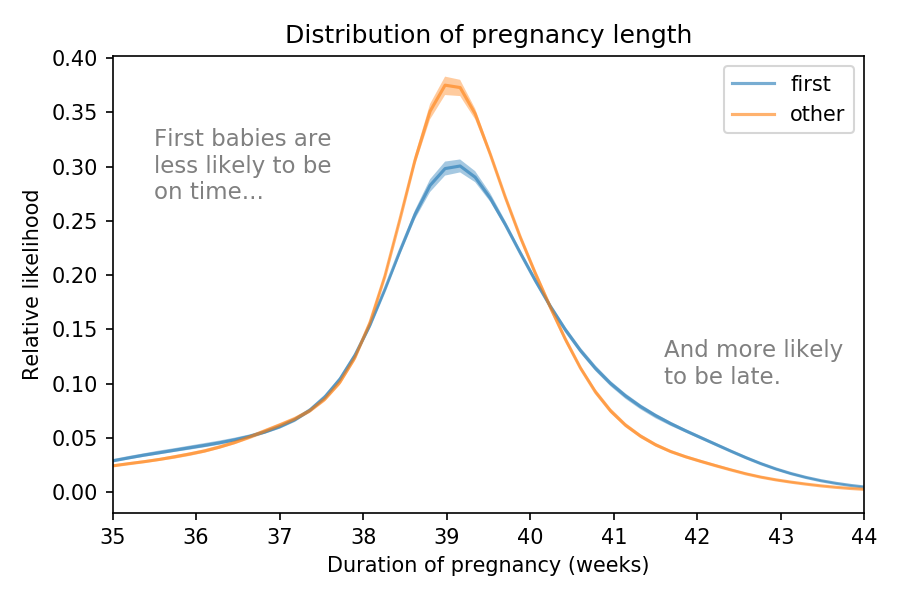
Starting time babies are less likely to be "on time" at 39 weeks, and more likely to be a little late, between 41 and 43 weeks.
Among full-term pregnancies, first babies are born almost 1.iii days afterward average. But the average doesn't tell the whole story.
How much longer?
Suppose you are at the starting time of Week 37. The boilerplate time until delivery at this betoken is 2.8 weeks.
Two weeks subsequently, at the first of Week 39, the average remaining time is 1.2 weeks. Every bit you expect, with each week that goes past, the average remaining time goes down.
Merely then it stops.
The post-obit figure shows the cruelest statistic in obstetrics: the average remaining time computed at the get-go of each week of pregnancy:
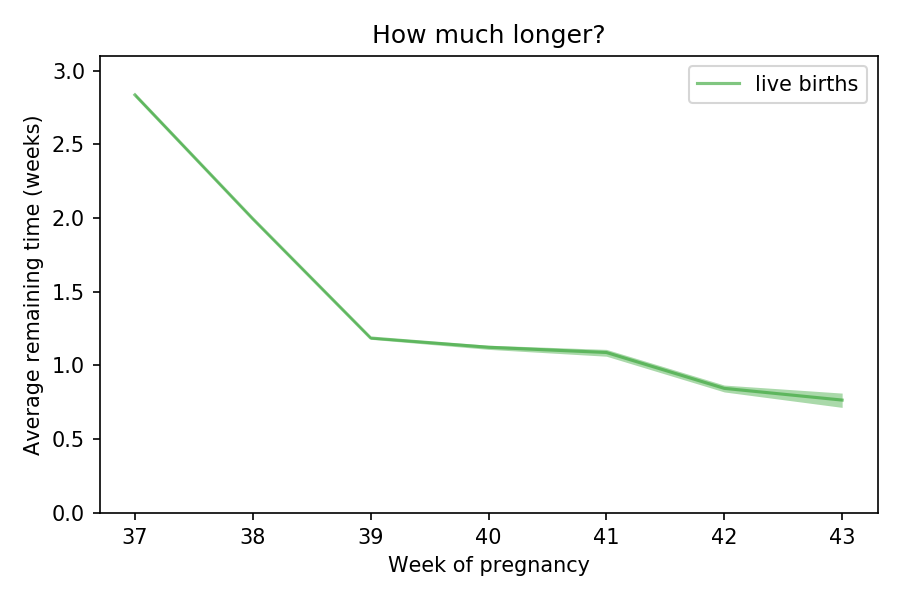
Between Weeks 39 and 43, the remaining time until delivery barely changes. Time goes by, simply the finish line keeps moving into the future.
At Week 39, if y'all ask a doctor when the baby will get in, they say something like "Whatsoever day now." If yous inquire once again at Week 40, they give the same answer. And again at Week 41. That might be frustrating to hear, but they are right; for almost five weeks, you are always one week away.
The state of affairs is a piddling worse for outset babies. The following figure shows boilerplate remaining fourth dimension for first babies and others:

At the beginning of Week 39, the average remaining time is 1.iii weeks for first babies and one.1 weeks for others. That departure is almost 36 hours.
The gap persists for a week or and then, merely after Week 41, first babies and others are indistinguishable.
Maybe this week?
Every bit you plan for the last weeks of pregnancy, the average time until commitment is not very helpful. You might prefer to know, at the first of each calendar week, the probability of delivering in the next seven days.
The post-obit figure answers that question for first babies and others:
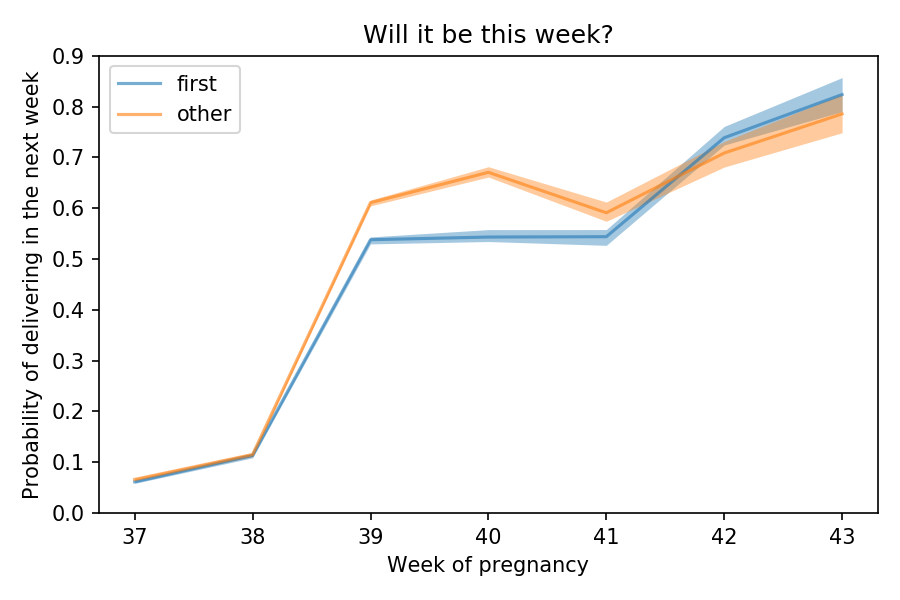
At the beginning of Week 37, you can pack a bag if you desire to, but at that place is merely a 6% adventure you will need it, outset babe or not.
At the offset of Week 38, the chance of delivering in the side by side week is about 11%, not much higher.
But at the start of Week 39, it is essentially higher: 54% for first babies and 61% for others.
This gap persists for a week or so; so later on Calendar week 41, the 2 curves are effectively the aforementioned.
Are these differences real?
The results in this article might reflect existent biological and medical differences between first babies and others. In that example, they are likely to be predictive: if yous are expecting your first baby, you will accept to await a little longer, on average, than for subsequent births.
Only these results might be due to measurement fault.
- By convention, the elapsing of pregnancy is measured from the first day of the mother'due south last menstrual period. The reported lengths might not be precise and might exist less precise for offset-time mothers.
- Likewise, NSFG data is based on interviews, non medical records, and then it relies on the memories of respondents. Reported lengths might be less authentic for first babies.
But even if measurement errors are different for beginning babies, it's not clear why they would be biased toward longer durations.
The apparent differences between first babies and others might besides be caused by a misreckoning factor related to pregnancy length.
- If a woman's first baby is delivered by C-section, subsequent deliveries are more than likely to be scheduled and less likely to exist late. I excluded deliveries by C-section for this reason.
- If first babies are less likely to be induced, more of them would exist allowed to be late. I don't know a reason they would be, just the dataset doesn't have information on induced labor, so I can't ostend or rule out this possibility.
The results I've presented are statistically significant, which means that if there were no difference between first babies and others, nosotros would be unlikely to see these gaps. The results are besides consistent over the grade of the survey, from 2002 to 2017. So information technology is unlikely that the credible differences are due to random sampling.
More reading
This article is based on a case study in my book, Retrieve Stats: Exploratory Data Analysis in Python, which y'all can download at no cost from Green Tea Press. Information technology is too available in newspaper and electronic formats from O'Reilly Media (Amazon affiliate link).
I published a similar analysis (based on older data) in my web log, Probably Overthinking It, where you lot tin read more than articles on information science and Bayesian statistics.
If you enjoyed this commodity, you might also like "The Inspection Paradox is Everywhere", which is almost a surprisingly ubiquitous statistical illusion.
Methodology
I used data from the National Survey of Family Growth (NSFG), which "gathers information on family life, matrimony and divorce, pregnancy, infertility, use of contraception, and men's and women's health."
The dataset includes records of 43 292 live births, of which I excluded 737 multiple births and 11 003 deliveries by C-department. I also excluded 3 cases where the elapsing of pregnancy was reported to be 50 weeks or more. This analysis is based on the remaining 31 906 cases.
The NSFG is representative of U.s. residents, but it uses stratified sampling, so some groups are oversampled. I used weighted resampling to correct for oversampling and to generate the confidence intervals shown in the figures.
The details of information cleaning, validation, and resampling are in this Jupyter notebook. The details of the analysis are in this notebook.
About the author
Allen Downey is a Professor of Computer science at Olin College in Massachusetts. He and his wife have two daughters: the offset was born a week early on; the second was two weeks late, later on a niggling encouragement.
Source: https://towardsdatascience.com/are-first-babies-more-likely-to-be-late-1b099b5796b6#:~:text=First%20babies%20are%20less%20likely,t%20tell%20the%20whole%20story.

Post a Comment for "First Babies Are Late on Time Due Date"